Black hole superradiance and boson clouds
Nov 26, 2026
·
1 min read
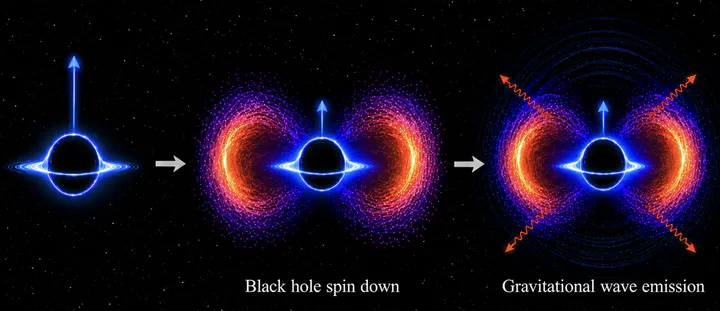
Ultralight bosons can form clouds around rotating black holes through superradiance. Their gravitational-wave emission offers a way to probe particle masses and black hole populations. My work includes search methodologies and analyses targeting scalar and vector clouds around isolated and merger-remnant black holes. Related research directions include gravitational atoms and molecules.
Selected publications
- Constraints on ultralight bosons from merging binary and remnant black holes observed during the second and third parts of the fourth LIGO-Virgo-KAGRA observing run · arXiv
- Directed searches for gravitational waves from ultralight vector boson clouds around merger remnant and galactic black holes during the first part of the fourth LIGO-Virgo-KAGRA observing run — Journal · arXiv
- Methodology for constraining ultralight vector bosons with gravitational wave searches targeting merger remnant black holes — Journal · arXiv
- All-sky search for gravitational wave emission from scalar boson clouds around spinning black holes in LIGO O3 data — Journal · arXiv
- Direct constraints on ultra-light boson mass from searches for continuous gravitational waves — Journal · arXiv
- Semicoherent analysis method to search for continuous gravitational waves emitted by ultralight boson clouds around spinning black holes — Journal · arXiv