Direct detection of ultralight dark matter
Nov 26, 2026
·
1 min read
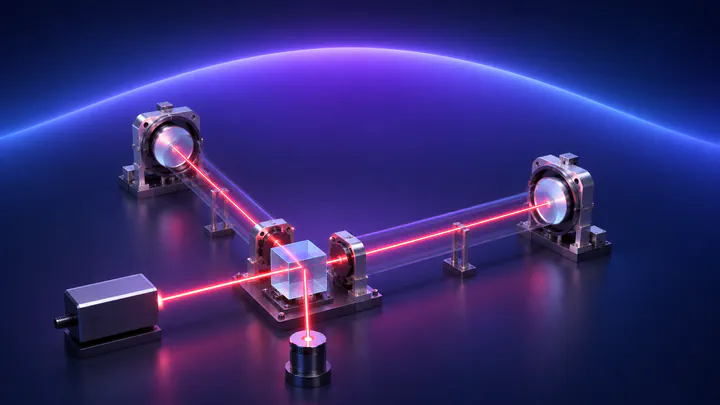
Gravitational-wave interferometers can act as particle detectors: ultralight fields may produce oscillatory forces or changes in material properties that generate measurable instrumental responses. My research develops methods to distinguish and constrain different dark matter interactions using ground-based and space-based instruments.
Selected publications
- Direct Multimodel Dark Matter Search with Gravitational-Wave Interferometers Using Data from the First Part of the Fourth LIGO-Virgo-KAGRA Observing Run — Journal · arXiv
- Gravitational wave probes of particle dark matter: a review — Journal · arXiv
- First search for ultralight dark matter with a space-based gravitational-wave antenna: LISA Pathfinder — Journal · arXiv
- Distinguishing between dark-matter interactions with gravitational-wave detectors — Journal · arXiv
- Constraints on dark photon dark matter using data from LIGOs and Virgo’s third observing run — Journal · arXiv
- Ultralight vector dark matter search using data from the KAGRA O3GK run — Journal · arXiv
- Prospects for Direct Detection of Ultralight Dark Matter candidates in deci-Hz Band with IndIGO-D · arXiv